“`html
Table of Contents
Key Takeaways
- The iPhone 17 price cliff is real: Trade-in values peaked late August, then dropped 10–30% after pre-orders opened.
- December still offers wins: Holiday gift cycles and carrier promos create short demand bumps you can ride.
- Lock a floor first: Get a GizmoGrind quote to protect against sudden dips, then test private sales or carrier offers.
- Use the 14-day sprint: Prep, price-check, boost value, lock or list, then close—simple moves that maximize iPhone trade-in in 2025.
- Pro models fell hardest: The 256GB base Pro fueled a big upgrade wave and pushed last-gen Pro prices down fastest.
The iPhone 17 launch price cliff is real, and it’s wild. Values rose fast before launch, then slid as pre-orders hit. If you missed the peak, don’t worry. This US-focused guide shows how to win in December. We’ll cover dates, prices, and a simple 14-day plan to maximize your iPhone trade-in in 2025. And yes, we’ll point you to GizmoGrind quotes and safe ways to stack deals.
What’s the “cliff”? Apple’s iPhone 17 lineup was rumored to drop on September 9, with pre-orders September 12 and retail on September 19. That created a gap where older model prices peaked, then fell 10–30% as the flood of trade-ins hit.
Now let’s turn that cliff into a ramp for you.
1) The iPhone 17 price cliff, explained (Holiday 2025 update)
What happened at launch: The pattern held strong. Trade-in values for iPhone 16, 15, and older models stayed high in late August, then slid 10–30% after pre-orders opened, as new models stole the spotlight and trade-ins surged. US demand was strong, and carriers pushed upgrade deals, so secondhand supply jumped fast.
Anchor the window: The launch window mattered. The iPhone 17 event window centered around September 9, with pre-orders around September 12 and in-store dates about a week later. That’s the classic pre-launch selling window for US sellers—7 to 14 days before the event.
Holiday 2025 lens: December can still work. Why? Gifts create last-minute upgrade cycles. Carriers extend promos to clear old stock. And folks prep for tax season, so they trade in now to free up cash. That creates short, sweet bumps in resale demand—even after the big drop. Pair that with a locked GizmoGrind quote and you can still beat the average.
Price expectations set the stage: Analysts said Apple would hold most pricing steady to keep the lineup accessible in the US, with the Pro getting a storage bump and a higher base price. That’s key, because it pushes more people to upgrade into Pro, which floods the used market with last-gen Pros. Expect more pressure on Pro/Pro Max resale values than base models.
Holiday punchline: You can still maximize iPhone trade-in in 2025. But you need a plan. Start now, and you can ride December’s mini-waves instead of falling off the cliff.
2) US prices and models: What the lineup means for your resale
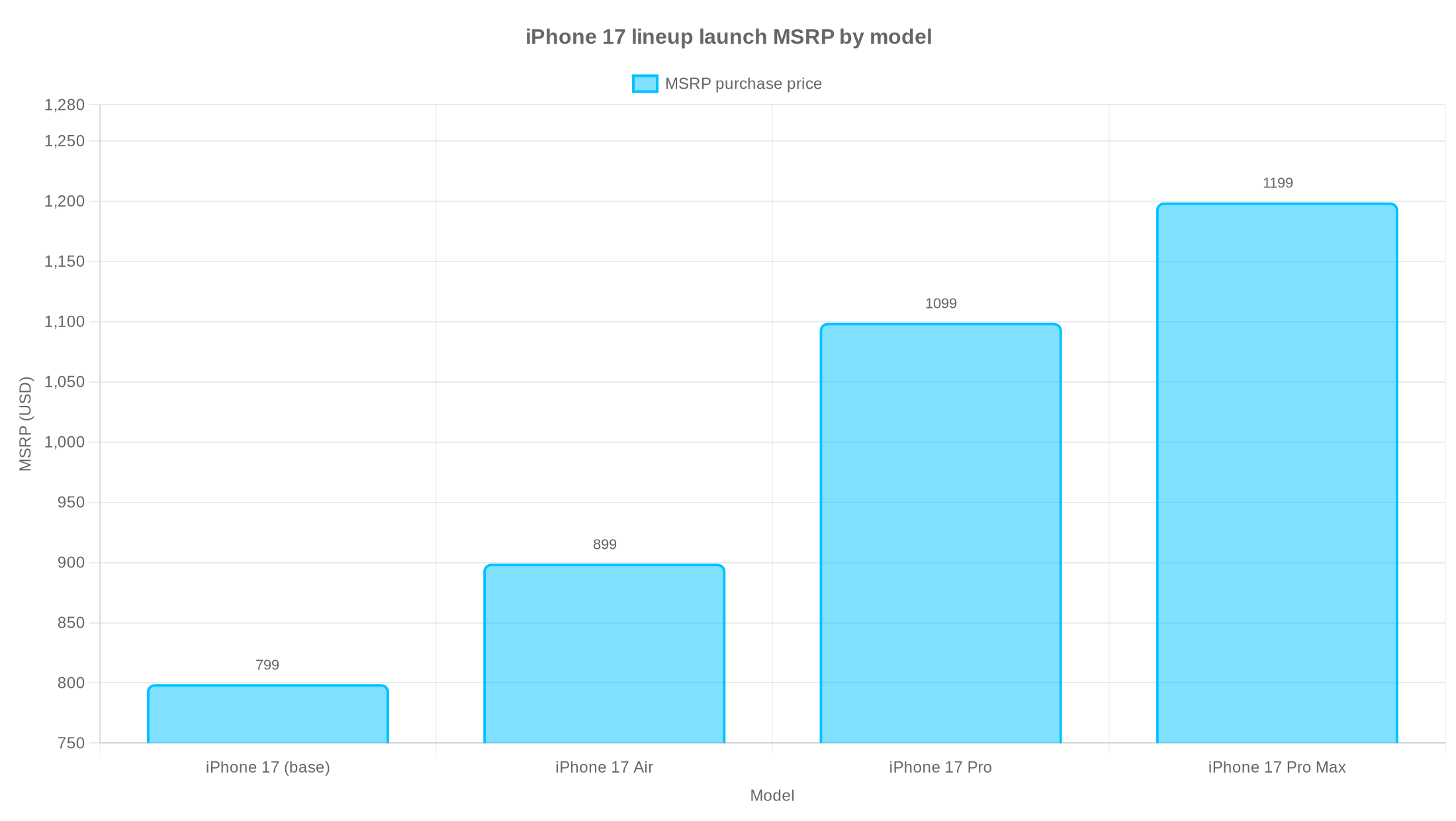
Apple guided for a steady lineup with selective changes. That shapes the iPhone 17 launch trade-in values we saw this fall:
- iPhone 17 (base): Estimated at $799, matching iPhone 16. This keeps base model demand broad, which stabilizes older base model resale.
- iPhone 17 Air: Tipped to replace Plus at $899–$949 thanks to a thinner design. Expect older Plus models to face a mild hit as thinness headlines grab buyers.
- iPhone 17 Pro: Expected at $1,099 but with 256GB base, ending the old $999-for-128GB norm. This is the big driver of Pro upgrades—and a big reason Pro/Pro Max used prices softened more.
- iPhone 17 Pro Max: Likely $1,199–$1,249, similar to iPhone 16 Pro Max. High storage demand kept many buyers in Pro Max land, but used prices still dipped with the upgrade wave.
J.P. Morgan’s take: With storage upgrades, the “effective” lineup cost stayed close to iPhone 16, which fueled upgrades and amplified the secondhand supply wave. That pushed the iPhone 17 trade-in value drop faster on premium last-gen devices.
3) The “cliff” by the numbers: When values popped, and when they fell
- Peak trade-in window: Late August to early September 2025. US demand for premium phones was strong, and upgrade cycles were healthy, so prices held right before the event. If you sold 7–14 days before launch, you likely got the year’s best clear—especially for iPhone 16 and 15.
- Post-launch drop: 10–30% decline in the 1–2 weeks after pre-orders open. That’s the true iPhone 17 price cliff. It hit Pros hardest, since so many traded them for the 256GB base Pro.
- 2025 vs 2026: Expect strong holiday demand to keep resale values steadier into late December. But 2026 could see tighter supply in parts (like memory) and slightly lower shipments, which nudges used prices down. Selling this holiday beats waiting for a softer market.
Note: Analysts projected Apple’s 2025 shipments at about 247 million units and revenue near $261 billion, driven by iPhone 17 demand—another signal of a big trade-in wave and faster dips post-launch.
4) State-by-state and carrier-driven value shifts (US focus)
Not all US markets behave the same. State taxes, metro demand, and carrier promos can change your net. During the holidays, a few factors shape your take-home:
Sales tax: High-tax states can make carrier bill-credit deals feel less sweet upfront, nudging more sellers toward cash buyback.
Local demand: Big metro areas move clean devices fast in private sales. Smaller markets can lag, so buyback becomes the safe floor.
Carrier promos: When “carrier iPhone trade-in promos 2025” hit a new wave, private prices dip. Watch Friday resets and holiday “last chance” pushes.
GizmoGrind tracks regional demand and timing shifts. See our data notes and mapping tips in our regional price differences case study. It shows why listing in the right high-demand metro or locking a quote early matters during the holidays.
Practical move: If you’re inside the holiday window, make a two-step hedge. First, lock a GizmoGrind iPhone trade-in quote as your floor. Second, list locally in a high-demand metro for 48 hours. If it doesn’t clear, ship the device to GizmoGrind and keep your guaranteed payout.
5) The 14-day sprint to max cash (works pre-launch and right now)
We keep it simple. Five tight moves. Two to three days each. Done.
Step 1 (Days 1–3): Prep for payout
- Back up your data.
- Sign out of iCloud. Turn off Find My.
- Check your IMEI/ESN. Make sure it’s clean.
- Gather proof of purchase.
- Shoot clear photos in good light.
See our full pre-sale checklist to avoid deal-breakers.
Step 2 (Days 4–6): Get three data points
- A cash offer from GizmoGrind.
- One carrier promo screenshot with all bill-credit fine print.
- A private-sale ask price from a comparable local listing.
These three numbers guide your choice and protect you from a sudden iPhone 17 trade-in value drop.
Step 3 (Days 7–9): Boost your value
Battery health matters. A device under about 90% often trades lower. Disclose it. Decide if a new battery is worth it for your model. Bundle your box, cable, and case for private sale. Note storage. Mid-tier storage is common, so compete with cleaner photos and full transparency on condition.
Step 4 (Days 10–12): Lock or list
- Lock a GizmoGrind rate if you need fast, guaranteed cash.
- Or list privately with a 48-hour acceptance window.
- Set alerts for carrier deal resets if you’re considering bill credits.
Step 5 (Days 13–14): Close the sale
Private sale: meet in a safe zone, reset the phone in front of the buyer, and take payment in a verified method. Buyback: ship with insurance and tracking, and keep your drop-off receipt. Time your finish for weekend traffic or the week before major holiday shipping cut-offs.
“Industry experts warn that activation lock is the number one deal-breaker for resale.”
Turn off Find My and sign out of iCloud before you list or ship.
6) Model-by-model value guidance for the launch window
Here’s how the iPhone 17 lineup shaped the curve for older models this fall, and how to play December:
iPhone 17 (base) effect: With the $799 base expected to hold steady, older base models (think iPhone 13–15) didn’t crash as hard as premium models. Clean, unlocked base devices still saw solid clears in December.
iPhone 17 Air effect: A thin, Air-style model at $899–$949 pulled some Plus demand. Older Plus models dipped, but full kits (box + cable) and high battery health helped private sales stand tall.
iPhone 17 Pro effect: The jump to 256GB base at ~$1,099 fueled big upgrade volume. That pushed a sharp iPhone 17 trade-in value drop on last-gen Pros in the first two weeks after pre-orders. December is steadier but still soft for Pro sellers.
iPhone 17 Pro Max effect: Similar story. Lots of trade-ins. Expect softer prices post-launch, then mild weekend bumps with gifting and returns.
Who should move fastest now:
- Owners of Pro/Pro Max with mid-tier storage and battery health under 90%.
- Anyone seeing new carrier promos for iPhone 17 in their area—those promos can pull used demand away from your listing overnight.
Who can wait a week or two:
- Base model owners with clean condition, great photos, and a recent battery swap.
- Unlocked phones in high-demand metros with holiday buyers still browsing.
December tip: If carrier promos favor the newest Pro, older Pro/Pro Max devices often net more with a cash buyback plus the freedom of an unlocked line, rather than bill credits that lock you for 24–36 months.
7) Multi-channel strategy: buyback vs. carrier promos vs. private sale
Here’s your decision tree:
- Need fast, guaranteed cash? Pick GizmoGrind buyback. It’s quick, online, and you can lock a quote to protect against weekly ticks.
- Okay with bill credits instead of cash? Carrier iPhone trade-in promos 2025 can be strong. Read the fine print on credits, line requirements, and term length.
- Comfortable with messages and meet-ups? Private sale can fetch a premium for pristine devices with full kits.
Smart stack: Lock a GizmoGrind quote as your floor, then test a private listing for 48 hours. If it doesn’t clear, ship to GizmoGrind. That’s how you hedge against the iPhone 17 price cliff while you hunt for a better private rate.
Real-world perspective on bill credits vs cash:
Here’s a quick post-launch snapshot of how monthly costs can feel after a trade-in on a carrier plan.
“Thankful for a decent iPhone trade-in value. Battery was abysmal. $26/mon isn’t terrible for the 17 Pro after trade.” — Hilbe (X)
Thankful for a decent iPhone trade-in value. Battery was abysmal. $26/mon isn’t terrible for the 17 Pro after trade. I need maximum battery for all the pictures and video I’m about to shoot! pic.twitter.com/8oHW5g35T1
— Chris Hilbert (@Hilbe) December 5, 2025
That $26/month looks nice, but remember to tally the full term (24–36 months), taxes, fees, and any add-line rules. Cash now vs. credits later is a personal choice. Just do the math before you jump.
Risk controls for every channel:
- Verify IMEI. No financing liens.
- Remove activation locks.
- Document every scratch in photos.
- Meet in safe exchange zones for cash.
8) Tools: checklists, templates, and a simple calculator
We built three handy tools you can use right now:
- A 2-page pre-trade-in checklist to prevent deal-breakers (activation lock is a big one!).
- A printable 14-day sprint calendar with reminders.
- A one-pager payout calculator to compare cash vs. carrier credits vs. private sale.
Grab the US-focused tools and our live trade-in context here.
Quick paper calculator you can run in 60 seconds:
- Cash buyback net: Your GizmoGrind quote minus any shipping upgrades you choose.
- Carrier net: (Monthly bill credits × term) + any instant credits − extra fees/taxes − required add-ons.
- Private sale net: Listing price − platform fees − commute/time cost estimate − risk buffer (we use a small 3–5% buffer).
Pick the highest net that also matches your need for speed and certainty. If it’s close, we suggest cash buyback. Less stress. Faster payout.
9) Risks, traps, and post-launch considerations
The iPhone 17 price cliff is not just hype. Values fell 10–30% after pre-orders, then flattened into smaller, uneven dips through December as returns and exchanges settled. Expect weekend bumps and short bursts tied to promos, but don’t count on a full rebound.
Common pitfalls to avoid:
- Activation lock or missing iCloud sign-out.
- Hidden financing liens.
- Opaque carrier bill-credit math that buries total cost.
- Waiting too long in a softening January market.
Battery health matters: “iPhone battery health trade-in value” is a real lever. Under ~90% can knock your offer. Don’t hide it. If a replacement costs more than the expected price bump, skip it.
Reminder: GizmoGrind does not accept iCloud-locked, blacklisted, lost/stolen, or water-damaged devices. We buy clean devices only, to keep trade-ins safe and eco-friendly for everyone.
10) State-by-state notes and where to list first
US iPhone trade-in state differences are real. If you’re near a big metro with strong private demand, try a short private-sale test:
- Strong holiday metros often include New York City, Los Angeles, San Francisco, Seattle, Chicago, Austin, Miami, Boston, Washington DC, and Atlanta.
- If your local metro is slow, target buyback first to lock the floor.
- Watch Friday afternoon promo resets from major carriers; they can shift private prices by Monday.
Check our regional price differences case study for a deeper dive on how these patterns play together.
11) December play calls you can make today
- If you own an iPhone 16 Pro or Pro Max with battery under 90%: Move now. Lock a GizmoGrind floor and try a 48-hour private test.
- If you own a base iPhone 15 or 14 with great condition: You can try a slightly longer private listing, but set a time limit. Don’t roll into January.
- If a carrier deal looks huge: Read the full term. Confirm bill credit length, any new line rules, and taxes. Screenshot the offer.
Holiday bonus: If you got upgraded Apple Watch or AirPods deals on Black Friday/Cyber Monday, you may see a second-hand accessory bump, too. Add cables and cases for a cleaner, faster sale. Rumors pointed to Watch Series 11, Ultra 3, iPad Pro, and AirPods Pro 3 at the 17 event, which fed that ecosystem buzz.
Frequently Asked Questions
What’s the best time to trade in iPhone before iPhone 17?
Late August to early September—about 7–14 days before the launch event. That’s when iPhone model trade-in values pre-launch are often the highest. See our date guide for the Sept 9 window.
I missed the pre-launch peak. What now?
Use the 14-day iPhone trade-in plan above. Lock a GizmoGrind floor, test a 48-hour private listing, and time your close for weekend traffic. Avoid mid-January softness as returns fade and promos shift.
How big is the iPhone 17 trade-in value drop?
History says 10–30% post-launch, with the fastest dips 1–2 weeks after pre-orders open. Then it smooths out. Learn more.
Private sale vs trade-in in the iPhone 17 era—what’s smarter?
If your device is pristine, unlocked, and you’re comfy meeting buyers, private sale may pay more. If you want speed and certainty, or your metro is slow, choose cash buyback. Stack smart: lock a GizmoGrind quote as a safety net.
Is there still time for iPhone 17 September 2025 trade-ins?
The peak passed, but December is still active. Gift cycles and promo resets can create short-lived bumps. Move now rather than waiting for 2026 softness.
13) Your next steps
- Get your GizmoGrind iPhone trade-in quotes now to set your cash floor.
- Pull one carrier offer and one local comp to compare channels.
- Pick your path: cash buyback, carrier credits, or a quick private sale.
- Use our pre-sale checklist and 14-day sprint to finish before January.
Holiday goal: Maximize iPhone trade-in 2025 and avoid the next dip.
Key sources for dates, prices, and market moves:
- Launch-related price dynamics and demand context: AppleInsider
- Release date context (US focus): GizmoGrind
- Price estimates by model: MacRumors
- Pricing and storage perspective (J.P. Morgan): 9to5Mac
- Pro Max timing and pricing background: Zeera Wireless
- Event companions and Air model buzz: YouTube
- Regional differences case study: GizmoGrind
- US-focused launch content and tools hub: GizmoGrind
- Pre-sale prep checklist: GizmoGrind
- Timing the sale playbook: GizmoGrind
The bottom line
The iPhone 17 effect on old iPhone prices was classic: a late-summer pop, then a post-launch cliff. If you’re holding an iPhone 16, 15, or older, you can still come out on top in December. Use a floor offer from GizmoGrind. Check a carrier deal. Try a quick private listing if you want. Keep your data safe, your photos clean, and your plan tight.
If you move now, you won’t fall off the cliff. You’ll glide right past it.
“`