Table of Contents
Key Takeaways
- Hidden costs can eat 30–40% of your cross-border phone sale—shipping, insurance, duties/VAT, platform fees, and forex all stack up fast.
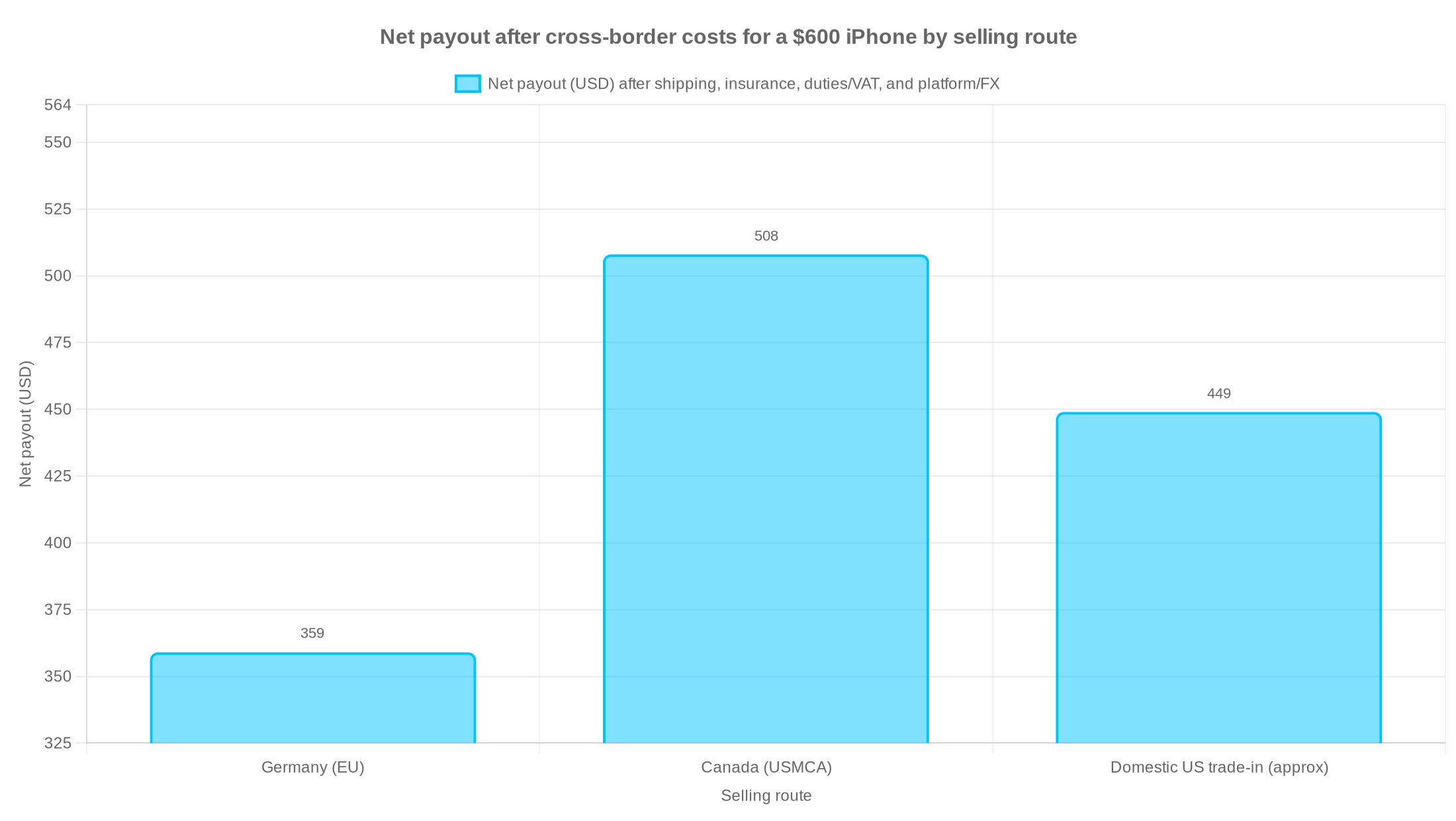
- A $600 iPhone sold to Germany can net you just $359 after all fees, while the same phone sold to Canada under USMCA may net $508.
- Fraud and payout holds spike on international routes—up to 25% of some US→EU phone sales face disputes or “item not received” claims.
- Our 60-day playbook walks you through route selection, privacy prep, currency locking, escrow use, and clean documentation to protect your payout.
- Sometimes a domestic U.S. trade-in beats risky cross-border deals on a net, risk-adjusted basis—compare before you ship.
Quick story: meet your $600 phone… and the leak
You sell a $600 iPhone to a buyer in Germany. It feels great—until the “extras” roll in.
Shipping with tracking: $45
Insurance: $12
Customs/VAT friction: $96 (often reimbursed to the buyer)
Platform + forex fees: $78
Total hidden costs: $231. That’s 38.5% gone. You net $369 on a $600 sale. Ouch.
These are 2026 example figures for US→Germany when you use typical international services and standard marketplace fees. Source: total cost model for a $600 iPhone sale, US→Germany (38.5% total hidden costs).
Why this is spiking now
May to July is busy. Folks have tax refunds. They upgrade for summer trips. Sellers rush to list. That speed is how fees sneak in.
But a little planning flips the script. We’ll show you how to nail the route, lock in a clean payout, and keep your identity safe.
The 2026 landscape in one glance
Cross-border phone shipping costs: Expect $20–$60 per phone for basic tracked service. Faster routes jump much higher.
International phone sale fees: Platform + payment + forex can hit 12–16% of the sale price.
International phone shipping insurance: 1–5% of item value, with deductibles on claims.
Phone trade-in customs duties and VAT: 0–16% duties in many markets, plus VAT up to ~20%, depending on the country. Buyers sometimes push you to cover it.
Phone resale currency conversion fees: 3–5% if you don’t control the rate.
Phone sale fraud protection 2026: Expect payout holds, “item not received” disputes, and return abuse if you skip proof.
All figures and trends above draw from 2026 export and marketplace summaries focused on U.S. sellers.
Shipping costs: the international hurdle
Here’s the simple truth: shipping is the first place your payout leaks. And the choices you make here matter.
Trackable services are non‑negotiable. USPS Priority Mail International often starts around $30 to Europe for a phone‑sized box. With proper tracking and delivery confirmation, you may land near $45–$60 to Asia. Carriers like FedEx and UPS charge more for speed—think $50–$100+ for express tiers. Duties are often collected on delivery. These are typical 2026 ranges seen across routes. Source for shipping range and carrier realities.
Know your lanes. US→Canada is often cheaper and simpler. US→EU/UK adds VAT customs friction. US→Asia can cost more and move slower.
Pack to prevent dispute. Anti‑theft packaging, inner boxing, and bubble wrap add about $5–$15 per shipment. Cross‑border returns for “not as described” can run you $40–$80 for the round trip. Source for packaging and return costs.
Compare label tools. Third‑party apps can shave $10–$20 off labels by pooling rates.
Useful resources:
Insurance: plug the holes, don’t overpay
Phones are high‑risk items. But many sellers ship with thin coverage, or they don’t know the exclusions.
Coverage gaps by default. U.S. marketplace protections can be narrow or have caps that don’t fully cover cross‑border loss or theft. Many sellers add third‑party shipping insurance in the $5–$20 range for up to $1,000 coverage per phone. Deductibles can eat 10% of claims. Source for cross‑border insurance gaps and typical add‑on costs.
2026 price pressure. Premiums climbed about 20% for high‑risk corridors after 2025. Routes to certain regions (parts of India or Brazil) cost more due to theft and loss data. Bundling insurance with smart routing can cut 15% off combined cost. Source for 2026 insurance trend.
Mind the IMEI rules. Unlocked phones can sell for 20% more. But if a device later gets blacklisted abroad, some policies deny claims.
Useful resources:
Customs duties and VAT: the rules that bite
This is where many deals go sideways. The terms are simple, but the costs can be big.
HS Code matters. Smartphones are classified under HS Code 8517 in most systems. Duties for phones can range from 0–16% depending on the country. The EU often has 0% duty on smartphones themselves, but VAT still applies on the entire import value. Source for HS Code and duty range framing.
VAT is not “just for the buyer” in practice. Buyers sometimes demand you reimburse VAT (or they refuse delivery). That pushes the tax back on you.
Non‑compliance risk. Get the paperwork wrong and you risk a hold or seizure. Fill out customs forms with clear descriptions and HS code.
Useful resources:
Fraud, holds, and payout pain: know the patterns
Cross‑border fraud looks like this: “item not received,” fake tracking screenshots, box swaps, or quick chargebacks. Don’t give scammers the angle.
Disputes are common. Reports peg up to a quarter of some US→EU phone sales running into “not received” or similar disputes. International holds can freeze your funds for 14–30 days on some payment rails. Source for dispute prevalence and payout hold timelines.
Conversion gotchas. Banks and platforms skim 3–5% on the exchange. Some marketplaces layer fees: seller fee + cross‑border + payment + forex. Don’t guess—price it in.
Verification wins. Ask buyers for a short unboxing video on delivery. Use escrow for deals over $300–$400. Or use platforms that manage customs and delivery.
Useful resources:
- PayPal seller protection basics and hold policies
- Escrow.com fees and process
- eBay International Shipping overview
Policy watch 2026: the de minimis line
The $800 rule. Shipments valued under $800 into the U.S. are often duty‑free (Section 321 “de minimis”). Phones with accessories can push past thresholds in other countries, so watch the total declared value, not just the device. CBP has been reviewing de minimis practices in 2026. Keep an eye on updates if you plan returns or cross‑border consolidations. Source for 2026 policy context.
Useful resource:
The math that matters: route models you can copy fast
Model A: US→Canada (USMCA context)
The draw: Lower friction, closer distance, strong demand, and many buyers pay in USD. Tariffs on smartphones are typically zero between the U.S. and Canada under USMCA. Taxes (GST/HST) may still apply to the buyer at import.
Typical 2026 cost picture on a $600 sale:
- Shipping + tracking: $25–$35 (ground/air hybrid)
- Insurance: $6–$12
- Duties: Often 0% tariff on the phone itself; buyer may owe GST/HST; check your listing terms
- Platform + forex: 8–13% depending on where the buyer pays and how you convert
- Return risk: Lower than many EU/Asia routes but not zero
Estimated total drag range: 15–25% if you keep currency in USD and use tracked, insured shipping. If you let the platform handle CAD→USD at its rate, expect 3–5% more loss.
Useful resource:
Model B: US→EU/UK
The draw: Big market. But you face VAT friction and longer logistics lines.
Typical 2026 cost picture on a $600 sale:
- Shipping + tracking: ~$45 to EU standard tracked
- Insurance: ~$12 for $1,000 coverage tier
- Duties/VAT: Duty can be 0–16% depending on classification and country rules; VAT often ~20% range and sometimes pushed back on you as a seller reimbursement
- Platform + forex: 12–16%
- Return risk: Higher than Canada; round‑trip returns can run $40–$80
Estimated total drag range: 30–40% if you reimburse VAT and let the platform convert currency. This aligns with the 38.5% example above. Source for EU/UK route costs and 38.5% model.
Which markets to favor in 2026
Choose low‑risk first. Canada and Mexico (USMCA) or the UK (streamlined entry) are safer than high‑fraud, high‑theft corridors in parts of Southeast Asia and some long‑haul routes. Tech tools like Shippo can cut label cost by $10–$20. Some buyback companies even offer cross‑border quotes at 85–90% of market value with ~10% fees, but read the fine print. Source for market selection and tool savings.
How to beat the fees: smart, simple moves
- Price with the right terms. Spell out who pays duties/VAT. “DDP” (duty paid) vs “DDU/DDP by buyer” changes your net a lot.
- Use a phone trade-in escrow service on deals over $400. You pay 1–3%, but it can save a full chargeback.
- Lock currency. Ask for USD, or pre‑convert at your bank or digital wallet with a known rate. That’s your USD–CAD currency hedging phone move. Don’t leave it to random marketplace rates.
- Document the device. Record IMEI/serial, take a 360° video, and grab photos of every side with today’s date. Turn off Find My and remove activation locks.
- Pack for success. Double‑box, pad edges, use tamper tape, and include a printed IMEI in the box.
“Industry experts warn that activation lock is the number one deal‑breaker for resale.”
Keep it off before you ship.
Your 60‑day cross‑border sale playbook (May–July)
Week 1–2: Map and model
1) Pick your route. US→Canada or US→EU/UK.
2) Pre‑quote on two platforms. Note all international phone sale fees.
3) Estimate shipping with tracking and insurance. Put real numbers in a sheet.
4) Choose duty/VAT terms. Decide if buyer pays or you reimburse.
Week 3–4: Privacy and proof
1) Back up and wipe your phone.
2) Turn off Find My and remove iCloud/Google account.
3) Record IMEI and unlock status. Unlocked phones often sell for more, but keep IMEI proof.
4) Build a “proof pack”: photos, condition video, and a short unboxing script for the buyer.
Week 5–6: Compare and commit
1) Get three final offers. Include a domestic trade‑in quote for a sanity check.
2) Run the net: sale price − shipping − insurance − duties/VAT − platform/FX − escrow.
3) Set a floor. If a deal drops below your floor, don’t chase it.
4) If selling to Canada, decide: USD or CAD. If CAD, pre‑convert at a locked rate.
Week 7–8: Prep the box, pick the lane
1) Book insured, trackable shipping. Keep the receipt in your file.
2) Print HS Code and IMEI on your customs form and packing slip.
3) State return rules simply. Who pays if “not as described”?
4) Add anti‑tamper tape and a small ID note inside the box.
Week 9–12: Close clean
1) For deals >$400, use escrow. Verify funds before shipping.
2) Share your unboxing script with the buyer. Ask for a 30‑second clip on delivery.
3) Watch tracking daily. If a delay hits, ping the buyer first.
4) Reconcile the fees. Save your math. Optimize the next sale.
Cross‑border net payout calculator (simple rules you can use now)
Start with your sale price. Subtract the known drags:
- Shipping + tracking: Use two quotes. Pick the higher one to be safe.
- Insurance: 1–5% of the declared value. Note the deductible.
- Duties/VAT: If you promise to reimburse, model the country’s VAT and any duty.
- Platform + payment + forex: Use the platform’s posted rates. Add 3% if you’re not locking currency.
- Escrow: 1–3% if you use it.
Net = Sale price − all the above. If Net < your floor, don't ship.
Case study: cross‑border vs a U.S. buyback
The device: iPhone listed at $600 market value in May.
Scenario 1: US→Germany marketplace sale
- Shipping + tracking: $45
- Insurance: $12
- Platform + payment + forex: 13% ($78)
- Duties/VAT reimbursement: $96
- Return buffer (probability‑weighted): $10
Net: $600 − $241 = $359 (rounded after you add a small return buffer). This is in line with the 38.5% example for EU routes. Source for cost model and 38.5% total.
Scenario 2: US→Canada direct buyer (USD price, buyer pays tax)
- Shipping + tracking: $30
- Insurance: $8
- Platform + payment: 9% ($54)
- Currency loss: 0% (paid in USD)
- Duties: 0% tariff; buyer handles GST/HST
Net: $600 − $92 = $508.
Scenario 3: Domestic U.S. trade‑in with a certified partner
Many certified buyback partners quote near market and remove cross‑border risk. After avoiding overseas shipping, duties/VAT, and forex, typical sellers can net 20–30% more than risky cross‑border deals when all costs are counted. Source for domestic‑vs‑cross‑border net framing.
Bottom line:
- If your only buyer is in the EU and wants duty‑paid terms, the cross‑border route may eat 30–40% of your sale.
- If you have a strong Canadian buyer and can price in USD, your net stays much higher.
- If you want fast cash with low risk and full privacy, a U.S. trade‑in (like GizmoGrind) may beat many global routes on a risk‑adjusted basis.
Privacy and compliance pack (mini checklist)
- Turn off Find My and remove all cloud locks.
- Sign out of Apple ID/Google and factory reset.
- Record IMEI/serial and the unlock status.
- Take front, back, sides, ports, and screen‑on photos with the date.
- Wipe SIM and eSIM profiles.
- Remove your case; clean the device gently; no liquid near ports.
- Print a device sheet: make, model, IMEI, battery health, condition notes.
Fraud control script (use it as a message template)
Before shipping:
“Hi! I ship with insured, trackable service. When it arrives, please record a 30‑second unboxing video that shows the label, the sealed inner box, and the first boot to the home screen. This protects us both.”
After delivery scan:
“Tracking shows delivered today. Please confirm safe arrival and share your quick unboxing video when you can. Thanks!”
Currency strategy: keep it boring and safe
- Pick your currency now. Ask for USD if possible.
- If you must take CAD or EUR, pre‑convert with a known rate at your bank or wallet.
- Avoid last‑minute platform conversions. Those “surprise” rates can take 3–5%.
- If listing for 30+ days, set a price band that covers rate swings.
Hidden fees selling phone online: spot them early
- Listing + final value fee + payment fee
- Cross‑border or “international” fee add‑on
- Forex conversion spread (the silent bite)
- Return label and restock costs on disputes
- “Delivery duties paid” upcharges if you offer DDP shipping
Platform combos can stack fees to 12–16% fast. If the platform also handles currency at its own rate, add 3–5% more. Source for 2026 fee stack patterns.
Best platform sell phone globally? It depends on your risk
Want reach? Big marketplaces bring buyers, but also fee stacks and fraud friction.
Want control? Direct deals with escrow cost 1–3% but lower chargeback risk.
Want simple? A domestic trade‑in avoids cross‑border headaches entirely.
When a U.S. buyback wins in 2026
- You need money fast (no holds).
- Your buyer pool is risky (long‑haul, high‑theft routes).
- You don’t want to handle VAT/duty fights.
- You care about privacy. A certified buyback wipes and processes devices securely.
About GizmoGrind: We help people across the U.S. sell used smartphones, tablets, MacBooks, Apple accessories, and smartwatches easily and securely. We do not accept iCloud‑locked, blacklisted, lost/stolen, or water‑damaged devices. Our process is fully online. We aim to get you strong value while supporting eco‑friendly recycling and responsible reuse.
Why act now
- Summer upgrades raise demand.
- May–July currency swings can be wild. Lock your rate early.
- Phones lose value every month. Plan in weeks, not months.
Frequently Asked Questions
Do I have to pay VAT when selling to the EU?
Buyers usually pay VAT at import. But some buyers ask you to reimburse. If you agree, add it to your price or your net will drop hard. Source for VAT reimbursement pressure.
Is insurance worth it for a $400–$1,000 device?
Yes. One loss wipes out your gains. Aim for coverage that matches device value, and note deductibles. Source for cross‑border insurance gaps and costs.
How do I stop “item not received” scams?
Use insured, trackable shipping, keep proof photos, and ask for a 30‑second unboxing video. For deals over $400, use escrow. Source for dispute trends and escrow tip.
What’s the safest market for U.S. sellers in 2026?
Canada is often the smoothest cross‑border route under USMCA. The UK is also workable. Some long‑haul routes carry more risk. Source for market selection.
How can I compare a cross‑border listing vs a trade‑in?
Use the net calculator above. Get a cross‑border estimate, then a U.S. trade‑in quote. Compare the true net after shipping, insurance, duties/VAT, platform/FX, and escrow. Many sellers keep 20–30% more by staying domestic, once all risk‑adjusted costs are counted. Source.
Your move: protect your payout today
- If you’re going cross‑border: pick the route, lock currency, use escrow over $400, and ship insured with tracking.
- If you want simple and safe: get a fast GizmoGrind quote. We’re online, secure, and eco‑friendly. No iCloud‑locked, blacklisted, lost/stolen, or water‑damaged devices—ever.
Useful links mentioned once for your toolkit
- 2026 cross‑border cost and risk overview
- USPS international shipping
- Shippo
- Pirate Ship insurance
- ShipStation insurance
- U.S. HTS (HS Code reference)
- EU VAT rates
- PayPal seller protection
- Escrow.com fees
- eBay International Shipping
- CBP de minimis (Section 321)
- USTR USMCA overview
Wrap‑up
Selling your phone across borders in 2026 can work—but only if you see the traps first. Ship with proof. Insure for the real value. Price with duties/VAT in mind. Lock your currency. Use escrow on big deals. And always compare your cross‑border net to a clean, domestic trade‑in.
Do the math once. Keep more money every time.