Table of Contents
Key Takeaways
- USD/CAD sits near 1.38–1.39 in early 2026, with forecasts pointing to 1.33–1.35 by Q4—a stronger loonie can lift your USD payouts on Canadian trade‑ins without changing your prices.
- Cross‑border selling 2026 USD CAD is all about timing: price and invoice in CAD, then convert as the loonie strengthens to maximize realized USD receipts.
- Canada’s Last Sale rule means your invoice must show the true final sale price to the Canadian buyer—keep it clean for fast customs clearance.
- A 60‑day playbook combining smart FX hedging, CAD‑first invoicing, and tax refund timing can add 3–5% to your USD margins.
- Watch the wildcards: Fed vs. BoC rate cuts, oil swings, and USMCA review headlines in July 2026—they can spike volatility fast.
Why USD/CAD Matters Now for Cross‑Border Sellers
If you sell phones to buyers in Canada, 2026 is your year to play the currency game smart. Cross‑border selling 2026 USD CAD is the talk right now. Why? Because many pros see the Canadian dollar—the “loonie”—getting stronger by year‑end. That shift can lift your USD payouts, even if your buyback price stays the same.
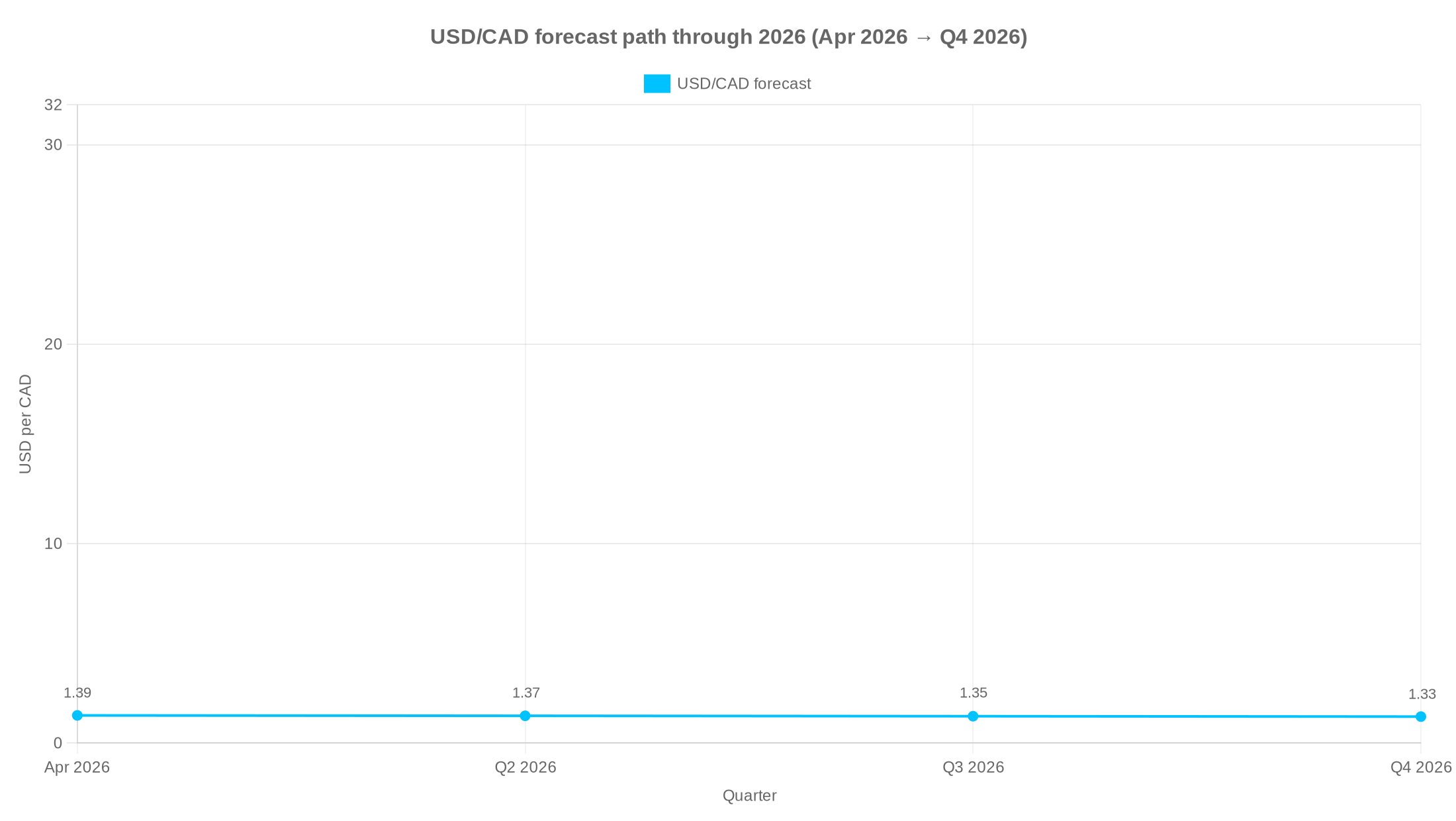
The story today: USD/CAD has hovered near 1.38–1.39 in March–April 2026. That means 1 USD buys about 1.38–1.39 CAD. Or flip it: 1 CAD is roughly 0.72 USD. Banks expect a slow move lower—toward 1.33–1.35 by late 2026. A lower USD/CAD number means a stronger CAD. If you collect in CAD and convert later, you may get more USD for the same Canadian price.
Here’s the snapshot: early 2026 levels near 1.38–1.39, with a short‑term range of 1.35–1.40 as markets juggle sticky U.S. inflation, higher U.S. yields, geopolitics, and oil swings. The broad 2026 view points to gradual CAD recovery on rate moves and steady commodities.
The takeaway for cross border phone trade‑in US Canada: if you price and invoice in CAD, then convert to USD as CAD strengthens, your realized USD receipts can rise without changing your buyback quote.
Forecasts, Volatility, and Wildcards U.S. Sellers Should Watch
Think of 2026 like a slow river. It flows toward CAD strength, but you still hit bumps.
Why CAD may strengthen: Markets see the U.S. Federal Reserve cutting rates faster than the Bank of Canada. That narrows the interest gap. Oil and other commodities look steadier. Canada’s data holds up. The five‑bank snapshot from RBC, CIBC, TD, BNS, and BMO hovers near 1.39 in April, drifting to 1.33–1.35 by Q4 2026.
Consensus target: 1.34–1.35 by year‑end; some see 1.33 if the Fed cuts faster.
Wildcards to track: the USMCA review in July 2026—tariff talk could shake markets—plus commodity price swings. Some views see the CAD and MXN wobble in Q2 before longer‑term trends reassert.
What this means for USD CAD forecast 2026 sellers: expect a CAD‑friendly drift. But plan for jolts. Build small buffers. This is USD CAD volatility 2026 in a nutshell.
Impact on Phone Trade‑Ins: The Simple Math That Moves Your Margin
Here is where it gets fun. A tiny move in FX can pad your payout.
- At USD/CAD 1.39 (April 2026), a CAD 1,000 trade‑in equals USD 719 (1,000 ÷ 1.39). This is your baseline today.
- At USD/CAD 1.35 (late 2026 view), that same CAD 1,000 becomes USD 741. That’s a gain of USD 22, or about 3%, with no change to your list price.
- If the pair touches 1.33, CAD 1,000 turns into about USD 752. Every tick counts.
Best practice: invoice and collect in CAD, then convert to USD on your terms. If you expect CAD strengthening 2026 trade‑ins, locking in CAD sales now can help. Just remember: shocks happen. Tariffs or oil jumps can flip the script short‑term.
“Last Sale” Rule in Canada: What U.S. E‑Commerce Sellers Must Know
This is your compliance anchor. Canada’s CBSA applies the “Last Sale” rule for e‑commerce imports. That means duties and GST look at the final sale price to the Canadian buyer—not an earlier sale in a chain, not a related‑party value.
The final sale sets the value. No undervaluing through a conduit with no staff on the ground. Audits target B2B2C chains that try to shift value away. For phone trade‑ins, be clear: your invoice must show the true CAD price to the Canadian buyer. That aligns with fast customs and fewer delays.
Note: The U.S. has a “First Sale” concept in other contexts. Canada does not use that for these imports. Phones often carry low duty rates, but GST/VAT rules still apply on the final price.
Cross‑border invoicing that fits the rule is simple and neat. Add the device IMEI/serial, buyer info, date, and sale terms. If you quote in USD, list the CAD equivalent, the exchange rate you used, and the timestamp. That helps customs, and it helps your books.
The 60‑Day Cross‑Border Selling Plan
Goal: Maximize USD payouts CAD trade‑ins with a clean, repeatable SOP. Think CAD‑first invoicing, smart timing, and light hedging. Aim this at April–June refund season and the pre‑launch buzz that hits before big phone drops.
1) Currency Planning
Set live FX alerts around 1.37, 1.35, and 1.33. Use non‑bank rate tools to check real spreads before you convert—non‑bank providers can cut markups. Confirm your “conversion window.” Pick a rule like T+2 business days after device receipt or after a fixed CAD balance is reached. This keeps it fair and fast.
For bigger balances, cap risk with small forwards or staged conversions. Hedge 25–50% to protect USD value while leaving some upside. (Volatility context: watch for oil and trade shocks.)
2) CAD Invoicing Cross Border Sales
Make CAD the “home” currency for Canada buyers. Put a USD equivalent on the invoice for clarity. Show the USD/CAD rate and a timestamp. This is clean, honest, and CBSA‑friendly.
3) Timing Your Promos
Line up offers with tax refund timing phone trade‑ins 2026. U.S. and Canada refund windows can drive fresh supply and demand. See our timing guide for fast wins.
4) Documentation and the Last Sale Rule
Keep the final sale value crystal clear. Show the Canadian buyer as the final counterparty. Avoid conduit chains that confuse value or control. Include IMEI/serial, condition grade, and accessories. Print two copies of the invoice and put one on the box. Customs likes simple.
5) Reference Playbooks
Build your currency hedging playbook US Canada with our step‑by‑step tips. Use our 60‑day cross‑border plan for device handling, invoicing, and shipping details.
Compliance and Invoicing: CBSA Last Sale Rule Imports, Simplified
Here’s your quick checklist to stay smooth at the border:
- Show the true CAD price on every invoice. This is phone trade‑in currency optimization 101. It matches the rule and speeds clearance.
- Avoid “shell” structures. If a middle company has no staff or presence in Canada, it can trigger extra checks.
- If you show a USD quote, include the CAD equivalent, the FX rate used, and the timestamp. Clear math = happy auditors.
- Print copies. One inside, one outside the box. Add IMEI/serial to link devices to the invoice.
Practical Payouts: Quick Math and Templates You Can Copy
Let’s run a simple CAD 1,000 example. These are illustrations to show how rates move your USD totals.
- At USD/CAD 1.39: CAD 1,000 ≈ USD 719.
- At USD/CAD 1.35: CAD 1,000 ≈ USD 741.
- At USD/CAD 1.33: CAD 1,000 ≈ USD 752.
Context for bands and year‑end drift: major banks cluster near 1.34–1.35 by Q4, with 1.33 possible if Fed cuts run faster.
CAD‑First Invoice Template (Copy/Paste and Tweak)
- Header: Your business name, address, contact.
- Buyer: Full name/company, Canadian address, email/phone.
- Device: Make/Model, IMEI/Serial, condition grade, accessories.
- Price: CAD [Amount]. USD equivalent: USD [Amount] at USD/CAD [Rate] on [Date/Time, ET].
- Terms: Final sale value reflects Last Sale to Canadian buyer. Duties/GST per CBSA rules.
Notes: Payment method, return terms (if any), and warranty note.
60‑Day Pre‑Promo Checklist
- Set FX alerts at 1.37, 1.35, and 1.33.
- Write your conversion rule (e.g., T+2 or at CAD 10k balance).
- Decide your hedge split (e.g., forward 30%, leave 70% floating).
- Audit invoices for Last Sale clarity.
- Map promo dates to tax refund weeks and pre‑launch buzz.
Print and pack two invoices per box (IMEI/serial included). Bookmark our cross‑border SOP.
Tools, Templates, and Processes You Can Use Now
A tight process beats guesswork. Here’s your playbook in motion.
Rate‑tracking protocol: Set alerts near consensus bands (1.39 high, 1.37 mid, 1.35 target, 1.33 stretch). Before you convert, compare your bank’s rate to a non‑bank provider to avoid heavy markups.
Documentation kit: Final‑sale invoice template with CAD amount, USD equivalent, FX rate, and timestamp. Buyer details, IMEI/serial, sale date. Two printed copies for CBSA.
Calendar: Align to refund inflows and device launch windows. Watch Bank of Canada and Fed decision dates. Note the USMCA review in July 2026. Headlines can move USD/CAD fast.
Risks, Guardrails, and How GizmoGrind Helps
Let’s keep it real. Currency can be your friend—and your foe.
Currency risk: Stage your conversions. Or hedge a slice of your CAD receivables 2026 with a forward. This caps downside while you keep upside. If Q2 brings choppy waters, you’ll be glad you hedged a bit.
Regulatory risk: The CBSA Last Sale rule is clear. Clean, final‑sale invoices reduce delays and re‑valuations. That keeps cash moving.
Market risk: Tariff talk tied to the USMCA review can spike USD/CAD. Oil can swing too. Watch rate moves from the Fed and BoC. These three forces set the tone.
How GizmoGrind fits: We power fast quotes and fast payouts for U.S. sellers and Canadian buyers. We do not accept iCloud‑locked, blacklisted, lost/stolen, or water‑damaged devices. This protects both sides and keeps deals clean. We care about reuse and safe recycling. Your old tech gets a new life.
“A small shift in the USD/CAD rate can lift your payout without changing your price.”
Do This in the Next 7 Days
- Pick your invoicing policy. We suggest CAD‑first with a USD equivalent on every invoice.
- Write your USD/CAD conversion rule. For example: “Convert T+2 after device receipt, unless USD/CAD breaks 1.35; then convert same day.”
- Turn on FX alerts at 1.39, 1.37, 1.35, 1.33. If USD/CAD pops to 1.39–1.40, consider converting part of your CAD now. If it trends toward 1.35, hold more CAD and reassess daily.
- Run a 15‑minute compliance audit. Does your invoice show the final CAD price, buyer, IMEI/serial, and FX timestamp? Good. You’re “Last Sale” ready.
- Map your 60‑day promo calendar to tax refund weeks and pre‑launch device cycles.
Deep Dive: The Backdrop Behind 2026’s CAD Story
If you like the “why,” this part is for you.
Interest rate driver: Markets think the Fed will trim faster than the Bank of Canada in 2026. That narrows the gap. A smaller gap often helps the CAD versus the USD.
Commodities: Oil and other Canadian exports matter to the loonie. Stable or higher oil can support CAD. Big drops can hurt it.
Trade and tariffs: The USMCA review in July 2026 can add noise. Some analysts note tariffs could touch less than 15% of U.S.–Canada trade, but headlines move FX anyway. Plan for choppy weeks.
Consensus path: Many desks point to 1.34–1.35 by Q4. Some see 1.33 if the Fed cuts more. But Q2 can be messy. StoneX flags the CAD and MXN may “lose ground” for a spell.
That’s why our guidance blends two ideas: aim to benefit from CAD strengthening 2026 trade‑ins, and hedge a bit for safety.
Real‑World Example: Your 60‑Day Path
- Week 1: Turn on FX alerts. Pick CAD‑first invoicing. Add USD equivalent and the FX timestamp field to your template. Print two copies per box. Post a “Canada‑smart” promo that peaks into refund weeks.
- Week 2: Stage your first conversions. If USD/CAD is near 1.39, convert 25% to reduce risk. Hold 75% if you aim for 1.35.
- Weeks 3–4: Watch BoC/Fed dates and oil moves. If markets drift CAD‑friendly, wait for 1.37–1.36 to convert another 25%.
- Weeks 5–6: USMCA chatter? Tighten spreads. Hedge 25% with a short forward if headlines heat up.
- Weeks 7–8: Review totals. If you see 1.35 or better, convert the rest. Celebrate the lift in USD payouts without changing your list prices.
Pro Tips from the Field
- Show both prices. CAD first, USD second. It looks pro and keeps everyone on the same page.
- Keep IMEI/serial on every doc. Customs and buyers love it.
- Use quick math in listings. Example: “CAD 1,000 (≈USD 740 at 1.35). Final USD depends on rate at conversion.”
- Revisit your “conversion window” once a month. Markets change. So should your rule.
Why This Works for Phone Sellers
You already know your margins on condition, model, and fees. Currency is the extra dial. It’s small but mighty. The difference between 1.39 and 1.35 on a steady flow of CAD 10,000 a month is about USD 220. Over a year, that’s real money—without raising a single price.
Early 2026 sits near 1.38–1.39. Many forecasts say 1.34–1.35 by Q4, with some shots at 1.33. Plan your play now.
Guardrails for Device Quality
A clean device speeds everything—quotes, shipping, and resale. At GizmoGrind, we do not accept:
- iCloud‑locked devices
- Blacklisted, lost, or stolen devices
- Water‑damaged devices
These rules protect buyers and sellers. They also protect your time.
The Bottom Line
The setup: USD/CAD near 1.38–1.39 today. Many banks see 1.33–1.35 by late 2026.
The edge: Price and invoice in CAD. Convert smart. A stronger CAD means more USD for you.
The plan: Use our 60‑day checklist. Set alerts. Define your conversion window. Hedge a slice. Nail the Last Sale docs.
The watch list: Fed vs. BoC cuts, oil swings, and USMCA review headlines.
Want the templates and SOP in one place? Grab our playbooks:
- Cross‑border currency hedging playbook
- 60‑day U.S.–Canada phone trade‑in plan
- Tax refund timing guide
Set your alerts. Tune your invoicing. Run the plan. Let the loonie do a little of the lifting for you.
Frequently Asked Questions
What is the “USD/CAD exchange rate impact trade‑ins” everyone keeps talking about?
It’s how the FX rate changes your real USD payout when you sell to Canada. Lower USD/CAD (a stronger CAD) means you get more USD per CAD sale. Example: CAD 1,000 turns into USD 719 at 1.39, but USD 741 at 1.35.
How do I “hedge CAD receivables 2026” without making it complex?
Keep it simple. If you expect choppy weeks, convert a slice now and lock a forward on a slice later. Leave the rest open. This splits risk and reward.
Do I need to change my invoicing?
If you sell to Canada, yes—opt for CAD‑first invoicing. Add a USD equivalent and note the FX rate and timestamp. This aligns with the Canada Last Sale rule e‑commerce and helps customs.
What about duties and GST?
Canada cares about the final sale price to the Canadian buyer. That’s the Last Sale rule. Phones often have low duty rates, but GST/VAT can apply.
What if tariffs pop up in the USMCA review?
Expect short‑term USD/CAD spikes on headlines. Keep offers nimble and use your hedge playbook during that window.