
Table of Contents
Key Takeaways
- USD/CAD volatility in 2026 has ranged from 1.3929 to 1.3483—a C$40 swing per $1,000 device.
- Tax-refund season and spring phone promos drive cross-border volumes, making March–May prime hedge season.
- Forward contracts and options let you lock 50–70% of CAD payouts, protecting margins without slowing sales.
- Multi-currency accounts and batch conversions trim fees and keep your payout band tight.
- A 60-day playbook maps volume forecasts to hedge ratios, macro dates, and guaranteed CAD quotes.
Why Hedging Matters Right Now (March–May 2026)
Tax refunds are rolling in across the US. Spring phone promos are firing in Canada. Activity is up. But so is FX risk.
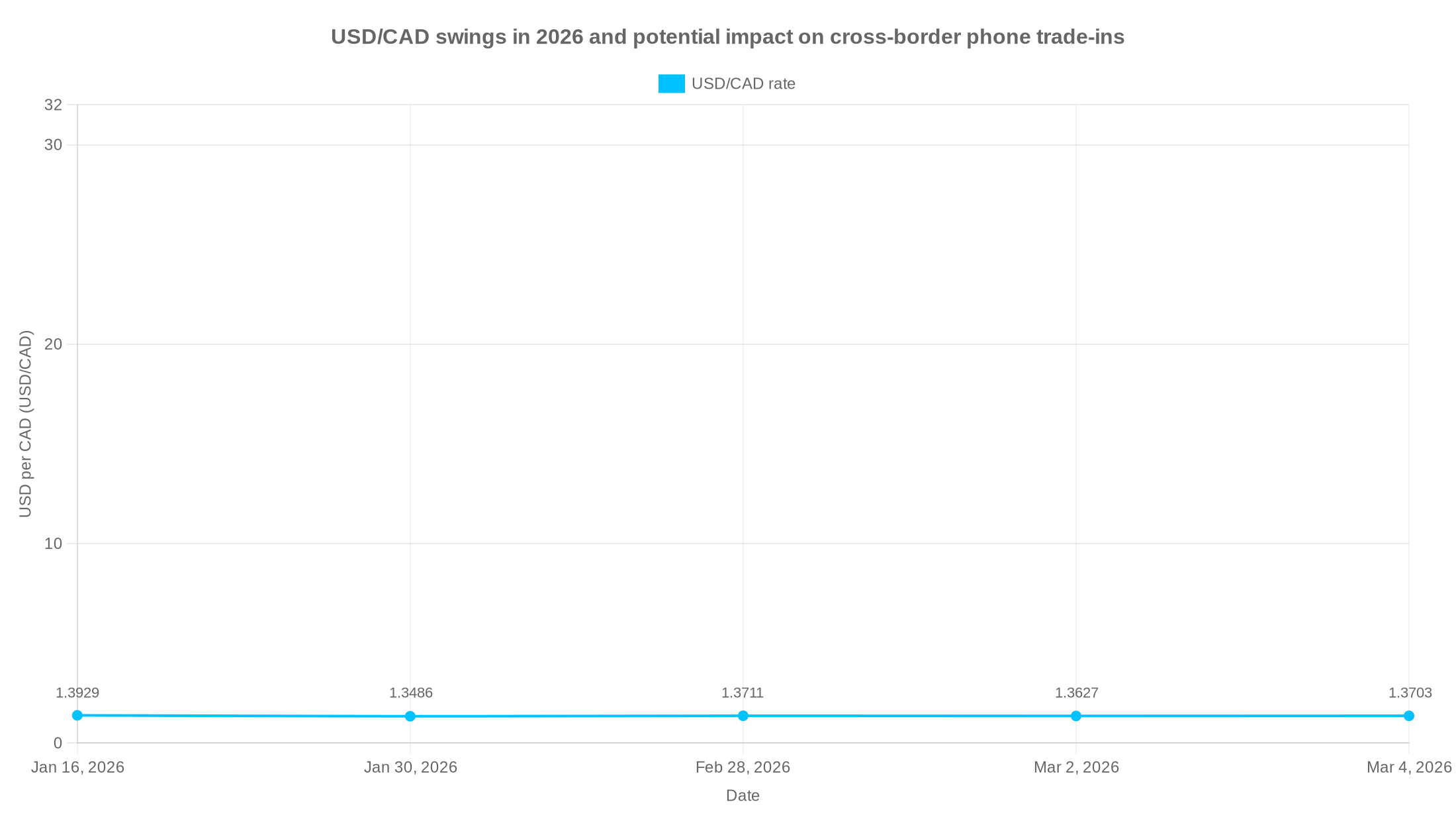
Here’s the story. In 2026, USD/CAD has swung between about 1.348 and 1.393, with an average near 1.371. That range is enough to shave 2–3% off your CAD payouts if you leave it to luck. Daily data shows an early-year surge and then a steady settle near the 1.37 line.
Key Dates and Levels
Let’s anchor that to dates. The highest rate this year was 1.3929 on January 16—friendly to US sellers, since one US dollar bought more Canadian dollars that day. The lowest rate came around January 30, at 1.3483–1.3486, which boosted the loonie and squeezed US-to-Canada resale margins.
The year average so far is about 1.3712–1.3718, with early March levels hovering 1.3627–1.3703. Recent prints sit around 1.366–1.370, up a tick on the day, with CAD/USD near 0.7299—a loonie worth roughly 73 cents US at spot. For intraday color and volatility, Investing.com’s data backs the choppy, but range-bound, feel.
What This Means for Phone Trade-Ins
At 1.39, a $1,000 US trade-in would map to about C$1,390. At 1.35, the same device would yield about C$1,350. That’s a C$40 swing per device. On 100 units, you’re out C$4,000. On 1,000 units, C$40,000. It adds up fast.
And markets think the loonie could keep firming into year-end. Analysts cite a Bank of Canada pause at 2.25%, a split from the Fed’s path, and solid trade flows that lift CAD—though oil and trade risks can still bite. Interchange Financial frames the pair as “stuck” near 1.3700 for now, but the drift risk still tilts toward a slightly stronger CAD if growth holds.
The Forecast Pack
Macquarie sees about C$1.31 per US$1 by year-end (CAD ~0.763 USD), with support from trade, but eyes on oil. ING and National Bank see CAD in the mid-0.70s (USD/CAD ~1.32–1.34) with a gradual climb. Longforecast has USD/CAD near 1.383 by December 2026, easing toward 1.342 by May 2027, signaling a loonie that could grind higher from here.
“A 2–4% swing is on the table. If your trade-ins hit Canada, hedging now can guard your CAD payouts when volume peaks.”
Bottom line for refunds and spring promos: if your trade-ins hit Canada, hedging now can guard your CAD payouts when volume peaks.
The Hedging Toolkit for Cross-Border Phone Trade-Ins
You do not need Wall Street gear. You need simple tools. Pick two or three that fit your flow. Then set a band, and stick to it.
USD/CAD Forward Contracts
Lock your rate ahead of time. It’s a deal to convert dollars on a future date at a set rate. For cross-border phone trade-ins, this smooths your CAD payouts even if spot swings. Lock 3–12 months for known cycles, like spring promos or back-to-school.
Pros: low friction, clear math, easy to size. Cons: you give up upside if spot moves your way. Use forwards for your base, recurring flow.
Currency Options for Cross-Border Trades
Options are like insurance. A simple setup is buying CAD calls (or USD puts) to protect if the loonie jumps stronger. Cost is the premium. You can also use a collar: buy a put and sell a call to lower cost but cap some upside.
Pros: flexible timing, protects tail risk on uncertain volumes. Cons: premiums and some complexity. This fits phone trade-ins with uneven timing across weeks.
Multi-Currency Accounts for Trade-Ins
Sit on CAD when you need it. Pay Canadian sellers from a CAD balance. This avoids constant spot hits. It also lets you batch-convert on good days. Fees can land near 0.5–1% with modern wallets. This is a great “always-on” layer for US to Canada trade-in hedging.
Operational Hedge via CAD-Held Inventory
This is a natural hedge. If you earn CAD on some sales and pay CAD to sellers or partners, you offset flows. Try to match your CAD in and CAD out within the same month. It lowers how much you must hedge with banks. Keep a simple sheet that nets your CAD receipts and CAD costs.
Portfolio/ETF Hedges (Advanced)
If you already hold listed funds, you can use CAD-hedged ETFs or short USD/CAD products to offset your device exposure. This is more advanced. It works best for readers with a brokerage account who want exchange-traded tools in the mix. For a plain-language explainer on how CAD hedges show up in funds, this short video gives helpful background.
Timing and Risk Controls
Start light. Hedge 50–70% of your expected exposure. Then add in small clips around key data: CPI, jobs, and central bank days. National Bank’s monthly FX brief flags the calendar you should watch, so you do not top up at the worst time.
A Practical 60-Day Currency Hedging Playbook (March–May 2026)
This is your simple map. Four phases. Sixty days. Clear steps. You can run this on a spreadsheet and two accounts. That’s it.
Phase 1 (Days 1–14): Volume Map and Exposure Sizing
Set your window. Track expected Canada-bound trade-in units for the next eight weeks. Add likely USD values per device. Convert that to a CAD payout band using the recent 1.36–1.37 range.
Open or confirm multi-currency accounts. Make sure you can hold CAD and USD. Test a small conversion to check fees and speeds.
Pre-book 30–40% of your two-week CAD need with short-dated USD/CAD forwards. Aim near current forward points. The goal: cover early April payouts with a stable rate so your promo can promise a number.
Set your payout band. For example: “We will target C$1,360–C$1,380 per $1,000 USD device.” This makes quotes clear and easy.
Phase 2 (Days 15–30): Lock the Core and Protect the Tail
Lift total hedge coverage to about 50–70% of expected April–May payouts. Use forwards to do the heavy lifting.
Protect the tail. Add a light options collar on 10–20% of the unhedged balance. This is backup in case CAD strengthens fast. Keep premiums low and tenor short. Think 30–60 days.
Align with macro dates. Check the National Bank brief and your econ calendar. Add or trim coverage on calmer days. Avoid big adds one hour before CPI or a BoC/Fed pressor.
Sanity check your quotes. Make sure your public or internal CAD payout figures line up with your actual forward levels.
Phase 3 (Days 31–45): Live-Quote Alignment
Compare your hedged rate to spot each morning. If spot improves and you’re under-covered, top up a little with a micro forward.
Batch your conversions in your multi-currency account. Avoid lots of tiny, random spot conversions. Wait for clean intraday levels when the spread tightens.
Track realized vs planned. Keep a small daily P&L log of hedge gains/losses. Your goal is not to “win” the trade. Your goal is stable payouts and steady margins.
Update your payout band if your hedge base shifts by more than 0.01 in USD/CAD. Communicate any changes early.
Phase 4 (Days 46–60): Pre-Peak Execution and Settlement
Finalize May promos with a CAD payout guarantee backed by your forward book. Be clear: the guarantee holds for a set window and includes a small protection fee.
Roll or close hedges as units settle. If some devices roll into June, roll your forward coverage the same way. Keep your 50–70% rule unless volumes jump.
Book gains/losses. Count your fees. Then calculate “margin preserved” versus an unhedged path. This helps you explain the value to your team.
Set your summer plan. Copy what worked. Drop what didn’t. Keep the muscle strong for back-to-school season.
Real-World Scenarios and Quick Math
Let’s walk it like we talk it. Keep it simple. Use round numbers.
Scenario A: No Hedge
You quote a $1,000 USD device for a Canada-bound buyer. At 1.39, you could pay out C$1,390. Spot slides to 1.35 by the time you settle. You pay out C$1,350 instead. You lost C$40 per device to FX drift. On 250 units, that’s C$10,000.
Scenario B: 60% Forward + 40% Spot, with a Tiny Fee
You book 60% at 1.3700 for expected settlements. The other 40% settles near a 1.3600 spot average. Your blended rate is 0.60×1.3700 + 0.40×1.3600 = 1.3660.
For $1,000, payout is C$1,366. You add a 1% “protection fee” to cover hedge cost and ops. Net to user: about C$1,352–C$1,355. Your variance shrinks, and your quotes hold steady.
Scenario C: Collar on the Tail
You keep the same 60% forward. You collar 20% of the remainder. CAD strengthens fast. Spot dives to 1.3500. The collar kicks in. Your blended rate still lands near 1.362–1.366. Your payout band holds. Users trust your quote.
Net-Payout Calculator Concept
You can do this in a tiny sheet:
- Inputs: USD trade-in value; your hedge coverage %; forward rate(s); expected spot window; option premium or fee; payout window dates.
- Outputs: blended CAD rate; gross CAD payout; protection fee; net CAD payout per device; margin preserved vs unhedged.
Remember, in 2026, USD/CAD saw a 1.3929 high and a 1.3483 low in January alone. That is your risk in one month of run-time, which is why we hedge your April–May window on purpose.
Implementation for GizmoGrind Readers: “Hedged Quotes” That Protect Value
Here’s how to make it work without slowing sales.
Offer CAD payout guarantees backed by USD/CAD forward contracts. Be clear with users. A small 1–2% protection fee is included. In return, their CAD payout stays inside a tight band, even if FX jumps.
Keep It Simple on the Back End
Set up multi-currency accounts so you can hold CAD and USD. Batch-convert, don’t drip-convert.
Choose a base hedge ratio of 50–70%. Size it to your next 30–60 days of expected Canada-bound payouts.
Align hedge tenors to payout dates. If you settle every Friday, book forwards that line up with those Fridays.
Track a target CAD payout band for your quotes. For example: “C$1,360–C$1,380 per $1,000 USD device,” updated weekly.
Automate quote templates with a validity window and the protection fee spelled out.
Sample “Hedged Quote” Language to Publish
“Your CAD payout is protected. We lock currency rates with USD/CAD forward coverage and options through your settlement window. A 1–2% protection fee is included to keep your payout within the C$X–C$Y band. No FX surprises. Just a strong, stable value.”
This model fits refund season perfectly. It maps to March–May volumes, keeps user trust high, and stops FX from erasing tight device margins.
Risks, Caveats, and Governance
Hedges tame risk. They don’t erase it. Keep a clean playbook.
Macro Levers to Watch
Oil can swing CAD. USMCA talks and trade headlines can jolt the loonie. BoC and Fed paths can diverge and move USD/CAD fast. Morningstar flags a CAD that can climb if policy and trade hold, but warns about oil and trade shocks.
Governance Checklist
- Position limits: cap total notional hedged vs forecasted payouts.
- Daily P&L check: know your hedge gains/losses vs device margin.
- Liquidity buffer: keep cash or line space for margin calls on forwards.
- Event plan: set triggers for CPI, jobs, and BoC/Fed meeting days using a calendar like National Bank’s monthly FX brief.
- Documentation: keep tickets, quotes, and settlements in one folder. Easy audits. Easy fixes.
Conservative Stance
Hedge real exposure only. No side bets. Scale in. If CAD weakens and you’re over-hedged, your device margin can swing the wrong way. Keep the 50–70% base unless volumes jump.
How Currency Swings Hit Phone Sell Values (and How You Counter Them)
A stronger loonie cuts CAD proceeds from US-dollar trade-ins when the pair drops from 1.39 to 1.35. Even a 0.02 move (say 1.39 to 1.37) can trim about 1.5% off per device, which pinches buy quotes and squeezes resale sites during promo season.
This feeds pricing pressure as Canadian buyers see US phones as cheaper in USD terms, which can push more cross-border units into the market and weigh on US resale values in the short run. On volatile pairs like USD/CAD, unhedged payouts can drop 2–5% across a choppy year, and 2026 has already posted swings over 4% end-to-end, which is why our 60-day playbook locks in stability right when volumes rise.
Your 60-Day Currency Hedging Playbook (Checklist + Calendar)
Here’s a one-page guide you can pin on your wall.
Week 1–2
- Forecast Canada-bound units and USD values.
- Open/confirm multi-currency accounts and test a small transfer.
- Book 30–40% forward cover for early April settlements.
- Set your payout band. Publish your quote validity window.
Week 3–4
- Lift total hedge to 50–70% for April–May.
- Add a light options collar on part of the tail.
- Check the macro calendar and avoid big moves before print days.
- Sync your public quotes to your hedge base.
Week 5–6
- Match daily quotes to hedge vs spot. Top up in micro clips if spot improves.
- Batch conversions. Avoid last-minute spot at bad prints.
- Keep a tiny P&L log. Aim for low variance, not FX wins.
Week 7–8
- Lock May promo payouts with a guarantee.
- Roll or close hedges as devices settle.
- Book gains/losses. Review fees. Measure margin saved vs unhedged.
- Clone the plan for summer.
Quick-Start Multi-Currency Account Checklist
- Confirm CAD and USD wallet support and local details.
- Check conversion fees and spreads.
- Test payout to a Canadian bank.
- Turn on two-factor and set user roles.
- Export a sample statement to be sure your accounting syncs cleanly.
Key Data Links to Keep Handy on Your Desk
- Morningstar’s CAD outlook, for the “why” behind a stronger loonie in 2026
- USD/CAD 2026 daily history (date-by-date peaks and lows)
- Another clean 2026 spot history view
- Interchange Financial’s USD/CAD forecast framing near 1.3700
- National Bank’s monthly FX brief for calendar timing
- Investing.com historicals to spot ranges and volatility
- Longforecast’s path view for USD/CAD into 2027
- A friendly explainer on CAD-hedged funds
The GizmoGrind Angle: Trade-In Value, Protected
We want users to feel safe selling their phones across the border. That means clean quotes, fast payouts, and no FX drama. Our readers can apply this playbook to protect phone trade-in value in CAD without slowing sales:
- Use USD/CAD forward contracts to set a floor under CAD payouts on expected units.
- Add light currency options for uncertain timing to cap worst-case swings.
- Pay from multi-currency accounts and batch conversions to trim fees.
- Stick to a 50–70% hedge ratio, then adjust around macro events using a calendar like National Bank’s.
Better for users. Better for margins. Better for the planet, too. Stable payouts keep devices flowing into reuse and recycling, which is core to what we do.
Frequently Asked Questions
What is a forward contract in plain words?
It’s a promise to swap USD and CAD later at a rate you lock today. You use it to make sure your future payout does not wobble with the market.
Are options worth it for phone trade-ins?
For variable timing, yes. A small option can cap a bad move if the loonie jumps. Keep it light to control cost.
How much should I hedge?
Start with 50–70% of what you expect to pay out in CAD over the next 60 days. Then add or trim in small steps as volumes and rates move. Check the macro calendar and avoid big moves before print days.
Why now?
Refund season boosts US device flow. Canada runs spring promos. USD/CAD is active. This is the best time to lock your payout math for April–May.
What if forecasts are wrong?
They often are. That’s why you hedge. You’re not betting the next tick. You’re protecting your payout band while the work gets done.
Final Takeaways
The setup: USD/CAD in 2026 has ranged roughly 1.348–1.393, with an average around 1.371. The early-year high was 1.3929 on Jan 16; the low, about 1.3483 on Jan 30. That alone is a C$40 swing per $1,000 device.
The near-term story: Markets see CAD firming into year-end if policy and growth hold, but oil and trade can shake that path. Don’t guess. Hedge.
The plan: Run the 60-day playbook. Lock 50–70% with USD/CAD forward contracts. Add light options on the tail. Use multi-currency accounts to batch and save. Align moves with a macro calendar.
Template You Can Copy Today
“Your CAD payout is guaranteed within C$[low]–C$[high] through our cross-border currency hedging (USD/CAD forward coverage and options). A 1–2% protection fee is included to lock value through your settlement window.”
Cross-border currency hedging does not have to be hard. With a few smart moves, you can turn USD/CAD volatility into stable phone trade-in value in Canada—right when refund season hits and every dollar counts.
Note: GizmoGrind helps people across the US sell used phones and tech the easy, secure way. We don’t accept iCloud-locked, blacklisted, lost/stolen, or water-damaged devices. Our aim is simple: fast quotes, fast payouts, and more value from old tech—with smart tools like this hedging playbook to keep your money steady.